Every shutdown has the same half hour in it. A bolted flange joint has to come apart, the gasket is welded on by twenty years of service, and someone reaches for a podger bar, a cold chisel and a lump hammer. It works, eventually — but it also accounts for a disproportionate share of hand injuries, damaged flange faces and gasket seats that never seal properly again.
There is purpose-built equipment for this, and it covers three distinct jobs — each with its own tool range and its own brand behind it. Understanding which tool fits which situation is what separates a controlled joint from a distorted one.
Enerpac FSC, FSH and FSM Series — Flange Spreading Wedges

When there is already a gap between the flange faces — once the bolts are out — the Enerpac FSC, FSH and FSM-Series wedge spreaders are the standard choice. These are Enerpac's own design: hydraulic wedge-type spreaders that slide into the existing access gap and open the joint under controlled, measurable force. The FSC needs only 6 mm of access gap to engage and can open to 80 mm using the stepped extension blocks provided.
Three variants cover different scenarios:
- FSC Series — the standard range, covering most flange sizes from DN50 to DN1200. Models include the FSC14, FSC21, FSC25, FSC35 and FSC42.
- FSH Series — heavy-duty variants for larger bore flanges and higher-resistance joints.
- FSM Series — mini variants designed for confined spaces and smaller flange sizes where the standard FSC cannot be positioned correctly. The FSM8 and FSM12 are the go-to tools for tight access situations.
All FSC, FSH and FSM spreaders are rated to 700 bar and come with safety lanyards as standard.
Equalizer SWi Series — Wedge Spreaders (Standard and ATEX)

The Equalizer SWi Series is an alternative wedge spreader range produced by Equalizer International — a specialist flange tool manufacturer acquired by Enerpac in 2019 and now fully part of the Enerpac group. The SWi range needs as little as 4 mm access gap and delivers up to 240 kN of spreading force when used in pairs. The slim jaw profile is designed specifically to fit between flange bolts, which makes a real difference on tight bolt circles where a wider tool will not sit flat.
The SWi range comes in two configurations:
- Standard (SPB suffix) — for general industrial environments. Options include the SWi2025TE STD and SWi2025TE MAX.
- ATEX-certified (EX suffix) — certified to II 2G Ex h IIB T5 Gb and II 2D Ex h IIIC T100°C Db, built to EN ISO 80079-36 and 80079-37. Required for Zone 1 or 2 gas atmospheres and Zone 21 or 22 dust atmospheres — refineries, gas plants, grain handling facilities, some mineral processing. "We've always used this one" is not a defence in a classified area.
ATEX variants include the SWi2025TE STD EX and SWi2025TE MAX EX.
Equalizer SG Secure-Grip Series — Bolt Hole Spreaders

Where the flange faces are hard against each other — no access gap at all, or there is a spacer ring, wafer check valve or butterfly valve between the flanges — a wedge spreader has nothing to bite on. This is the job the Equalizer SG Secure-Grip Series was designed for. Like the SWi range, SG is an Equalizer International product now part of the Enerpac group.
The SG range uses expanding collets that lock into the flange bolt holes and pull the mating flanges apart. Because the tool is anchored in the bolt holes rather than jammed into a gap, it cannot be ejected from the joint — a meaningful safety advantage over improvised wedge methods on fully-mated flanges. The inline SG18TE and SG25TE models handle applications where access is restricted to one side of the flange.
Sizes run from SG4 through to SG25, covering bolt holes from 14 mm to 83 mm in diameter. Bolt hole diameter is the key measurement — once you have that number, the model selects itself.
Enerpac FC10TE, Equalizer TFA and FA Series — Flange Alignment Tools

The alignment problem is the reverse of spreading. The new spool is in position, the gasket is seated, and the bolt holes are out of line. Hammering the flanges together damages the gasket face and creates the very leak you are trying to prevent. Forcing misaligned flanges and bolting up produces a joint under pre-load stress that fails before its time.
The Enerpac FC10TE is a hydraulic flange pulling tool that draws faces together and aligns holes under controlled load. It works on flanges with a bolt hole of 25.4 mm or greater and handles up to 90 kN. The FC10TE is an Enerpac design, separate from the Equalizer range.
For heavier or more complex alignment, the Equalizer TFA Series (Topside Flange Aligner) and FA Series cover a wider range of flange sizes and orientations — both are Equalizer International products, part of the Enerpac group. Available models include:

Why two tools, always
Every manufacturer's instruction sheet says the same thing, and it is worth repeating: a minimum of two flange spreading tools must be used when opening a joint. One tool on one side tilts the flange, loads the studs unevenly and concentrates force where you do not want it. Two tools placed 180° apart keep the faces parallel as they separate. It is the difference between opening a joint properly and distorting one.
The cost that does not appear on the purchase order
A wedge-and-hammer job is usually costed as free, because the tools are already on the truck. The real costs sit elsewhere:
- Damaged flange faces. A chisel mark in a gasket seat means the joint leaks. Then you are hiring a flange facing machine to re-machine the face in place — or cutting out the spool.
- Hot work. Flame cutting a seized nut needs a hot work permit, a fire watch and typically a full isolation. A hydraulic nut splitter removes the nut cold, without touching the stud.
- Time. On a bolt circle with twenty seized nuts, the difference between splitting and grinding is most of a shift.
- Injuries. Hands, mostly. A hydraulic spreader with no pinch points and a safety lanyard removes most of that exposure.
Choosing the right tool
Three measurements determine which tool applies:
- Access gap between the flange faces — measured, not estimated
- Flange size and pressure class (or the OD and bolt count if the spec is not available)
- Bolt hole diameter — the critical measurement for SG Secure-Grip and alignment tools
With those numbers:
- Gap of 6 mm or more → Enerpac FSC, FSH or FSM
- Gap of 4 mm or more, slim bolt circle, or ATEX area → Equalizer SWi
- No gap, spacer or valve in between → Equalizer SG Secure-Grip (bolt hole diameter drives model selection)
- Hole misalignment → Enerpac FC10TE or Equalizer TFA / FA
Add area classification to that — Zone 1/2 gas, Zone 21/22 dust — and the ATEX decision is settled.
Purchasing and support
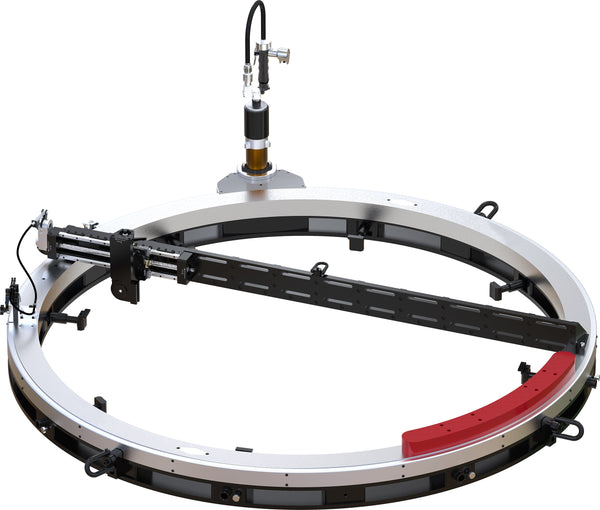
AD Automation supplies, services and repairs the full Enerpac and Equalizer International flange tool range — spreading wedges, Secure-Grip spreaders, valve change-out tools, alignment and pulling tools, nut splitters and portable flange facing machines — from our Keysborough workshop in Melbourne's south-east, shipping Australia-wide. We strive to turn around quote requests as quickly as possible.
Request a quote or call us on (03) 9798 7522.